Insights From One Year of Coronavirus
We always say that even when there are problems and challenges, it’s fine, as long as you learn from it and draw real conclusions. The past year of Corona undoubtedly threw up countless challenges and was felt by every single business, but as they say, the size of the challenge matches the size of the learning potential: how does our business run digitally, day to day, in an emergency? What’s our potential? How do we operate from here on? What digital transformation processes do we actually need? All of these questions, and plenty more, came up this past year – and were answered successfully. We’re happy to share the insights here:
Taking stock
Corona and the changes it brought didn’t leave a single business exactly where it started. Businesses can be split into a few types: businesses that profited and grew because of the situation (mainly in food and beverage, computing, ecommerce, and similar fields); businesses that saw a decline in activity and adapted to the new reality; and businesses that were hit hard, to the point of a complete halt. There are a few sectors and professions that, unfortunately, given the situation, hit a complete standstill.
It’s worth noting that businesses that invested in solid digital and ecommerce infrastructure ahead of time were able to keep running well even through Corona, and through the lockdowns in particular. We saw this clearly among some of our own clients who chose to invest in digital and ecommerce infrastructure that helped them get through this challenging year.
Of course, plenty of businesses added products, built out infrastructure, and reinvented themselves. We won’t dwell on that here, since it’s already been discussed plenty. Still, it’s a natural step in running a business through this period: obviously, a conference can become a digital asset, and obviously, a physical sale can become an online sale. So instead of going over ground that’s already been thoroughly covered, let’s share a few different insights.
Response
The Corona year forced a lot of businesses to define their products from the ground up, properly, for the first time. What do we actually need? Leads? Selling online courses? Ecommerce? Branding? With their backs against the wall, we saw plenty of businesses zero in on specific products and services and focus their entire operation around them – which, in our view, is a welcome shift. Pre-Corona, business flowed in steadily from phone calls, foot traffic, referrals, and a mix of marketing channels that customers found hard to tell apart. But during lockdown, everything became focused and clearer, and digital – its goals in particular – became far more present.
First and foremost, our recommendation to every client and to the business community at large was, and remains: don’t stop. As long as a business exists and is able to, it should keep marketing. Of course, you can adjust the dosage and mix of advertising, but if at all possible, it’s better not to stop entirely. Why? First, ad platforms unequivocally favor advertisers who advertise continuously. Continuous advertising maintains a high, necessary score. If you stop, coming back afterward can mean a slowdown that takes weeks, even months, to fix – in SEO as well as in paid promotion. SEO takes many months to build, and in our view, pausing it isn’t advisable if you’re able to keep it going. Whoever kept promoting throughout this year came out ahead, and we’ll demonstrate and detail that in a moment. Another important point: if your competitors keep advertising, they’ll capture a bigger slice of market share. And it’s worth remembering – on social media, we’re building complex, long-term relationships between our brand and our target audience, including affinity and interest that need to survive a crisis too.
First, we need to understand how to adapt our messaging to the new reality: precise, fast, dynamic messaging is critical when shifting between emergency, routine, and lockdown. Flexibility and agility are essential if you want the ability to respond quickly to changing conditions. Precision in messaging is critical. For example, if your competitors deliver within 10 business days, a message like “delivered to you within 24 hours” can shift results significantly in your favor. A range of messages were, and still are, necessary – whether it’s business as usual, or a sharpened marketing message pinpointing exactly what problem we can solve for our customers right now.
It’s also worth noting that a lockdown period is actually a great time to invest in content – simply relevant, intriguing, well-aimed content.
By some estimates, our customers’ time spent on mobile during lockdown jumped by hundreds of percent.
 What's your preference? Zoom / Teams / Hangout?
Deals, ladies and gentlemen, deals
We talk about this at length, but the Israeli audience is, without question, an audience that favors sales and deals. The Corona period made that conclusion clearer than ever. Plenty of businesses and brands shifted into a permanent “always-on sale” mode, running a standing 20% off the entire store. The scale of the discounts obviously varies by field, depending on the business model and what’s worthwhile, but we clearly saw that brands who adapted to the new reality got a strong, impressive response.
Digital lab experiments
Once messaging is dialed in, you need to route the right budgets and campaigns. First, in our view, it’s best to keep critical core campaigns running – brand campaigns, remarketing, basic ads – simply so the business keeps standing out even during this period. Beyond the core campaigns, this is where it gets interesting. All the rules changed, and now we could take a deep look at how a business performs under extreme conditions we could previously only imagine testing, and even then, not nearly as effectively as in this real-time experiment.
What happens when every branch of a chain closes and there’s only online? What happens when every other advertising channel for the brand shuts down – no walk-ins, no random phone calls, just digital? What happens when a client shuts down 3 local campaigns and 2 international campaigns, and puts the entire budget into one strong campaign in Israel, on one especially profitable product?
Well, the answer is genuinely interesting – we see results, and we see them clearly, in a way that’s very measurable, even more than usual. Plenty of businesses learned they actually perform better with a different staffing setup, or under different conditions. We even have clients who simply shut down their physical office because they finally realized they didn’t need it – or as we like to say, that meeting could have been an email.
Are customers still spending?
Unequivocally, yes. We saw a big rise in online sales. Plenty of online stores jumped 50%, 100%, and in extreme cases even 900% during the lockdowns. Visitors are buying at healthy volumes – including products that are far from emergency essentials, like jewelry, accessories, and more. Of course, the reality isn’t simple – there are hundreds of thousands of unemployed people, households whose income dropped by half, and plenty of difficult situations. But on the flip side, closed malls are driving a jump in other areas, and families have built up disposable income from cutting out nights out, spending, and shopping. One important point worth remembering: as long as the skies stay even partially closed, there are fewer flights, which means a lot of disposable income among the flying public, who also aren’t buying plane tickets or shopping abroad. We’d guess Israelis spend most of their disposable income on flights and shopping abroad. Fortunately, right now that’s not the case, and the public is genuinely shopping more locally and less abroad. (Not that we’re against tourism or travel abroad – we’re simply in favor of local purchases.)
How visitors behave during lockdown, and why organic promotion is critical
Given a lockdown, customers are home. And at home, as mentioned, they’re on their phones far more hours – hundreds of percent more hours. And what are they doing? Searching. We saw a clear rise in search volume across every lockdown. For example, a term like “wooden spoon,” searched by around 250 Israelis in a normal month, jumped to 700 searches during the first lockdown, and 980 during the second. That’s not a seasonal trend. Just to illustrate, here’s the search graph for “wooden spoon” between 2020 and 2021.
 Demand for the term "wooden spoon," 2019 vs. 2020
We saw the jump not only in cooking- and home-related terms, but across other terms too. We can say with confidence: given free time, the general public unquestionably Googles more.
We always recommend investing in organic promotion, but this year we saw clearly that clients who had invested in SEO ahead of time enjoyed a massive jump in traffic and performance with every lockdown – without needing any extra budget. And even when there’s a huge jump in demand, paid advertising still faces competition and limits on how much exposure you can buy, while in organic, at the top positions, that limit doesn’t exist.
How do you sleep well at night? The answer might be on your website
We always say a good website is one you can sleep well at night knowing it’s handling thousands of visitors. That’s easy to say in hindsight, but it’s an important lesson: a business that invested in its site, design, and strong digital marketing infrastructure reaps the benefits even during a crisis. Digital infrastructure you’re proud of and believe in will serve you well both in routine times and in an emergency. The difference is that in an emergency, especially when physical space is shut down, digital space is where you’ll be exposed to the largest share of your potential customers. Whether it’s an excellent, precise website or a post you’re proud of and hoping as many people as possible see, you need to invest in healthy, solid digital infrastructure.
It’s worth remembering that the digital world during Corona and lockdown is the exact same digital world as during routine times. Same platforms, same Facebook, same Google. Just the mix and the planning are a bit different.
Our recommendation: don’t wait for the next crisis to go digital – it’s worth being digital ahead of time, both in your business infrastructure and your organizational infrastructure. As an organization, we’ve always lived on laptops, shared documents, and Google Hangouts (yes, that’s really our tool of choice), and we’ve been well-practiced at working from home for years – it’s just that now the rest of the world caught up to close the gap and align with what was, for us, already the standard. With all the hardship and challenges Corona brought on businesses, brands, and families, in our view it also gave humanity a kick in the pants and jumped us forward several decades.


Still curious?
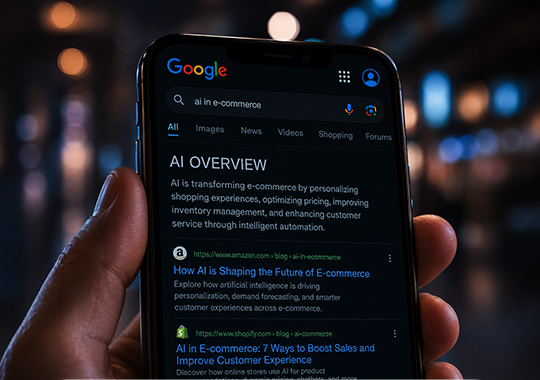
Is Your Website Ready for the Big Shift? AI Overview Is Changing the Rules of the Game

How Do You Create Content Built for the AI Era?