How Do You Create Content Built for the AI Era?
AI-based chat tools are sweeping users off their feet, and plenty of brands come to us with a clear brief: we want to be there. The answer to “how” is a bit complicated, since we’re talking about sophisticated engines that shift from user to user and week to week. Our approach: start by adapting your content for the AI era – and in this article, we’ll explain exactly how. It’s worth remembering that it’s genuinely hard to understand how AI really works, hard to measure it, and hard to track its changes. What’s easier is working backward from the end goal. Let’s get into it.
Like search engines, AI crawls your website too
It’s true that AI engines lean on data from search engines – Gemini draws on Google results, ChatGPT draws on Bing’s. But that’s not the whole story: AI crawlers also access your website directly to scan your content and understand what it’s about, largely to feed the model more information. So the first step is adapting your content for Google and other search engines. The same tried-and-true criteria for search-optimized articles apply just as fully to chat engines.
- A relevant headline containing the keyword
- Articles of at least 800 words
- Break content into subheadings, each covering a specific part of the topic
- Include images throughout the article
- Internal links to relevant pages
- Unique content that isn’t duplicated across other sites
- Don’t over-repeat the keyword (cap it at around 3 mentions)
- Use a clear heading hierarchy from H1 to H2 and beyond (heading types search engines can read)
- Clear structure – well-organized, clearly defined paragraphs
- Add schema markup to your pages (an important indexing tool)
Test it yourself – ask a chatbot a few general questions and you’ll see that almost every article it surfaces meets these criteria. The classic fundamentals always work, and they’re likely to keep working. Just like most of us still sit down and drive to work in a car with wheels – some things aren’t changing anytime soon.
Promoting your content in search engines
Our in-depth testing shows that the vast majority of content surfacing in chat tools is content that already ranks in search engines and appears for identical or similar queries there. So effective SEO also boosts your visibility in AI engines. Effective promotion includes on-site optimization – changes within your own website – and off-site optimization, changes beyond it.
An article needs to be crawled and indexed by a search engine to show up in chat results at all. Search engines crawl most websites periodically and index them if everything checks out. That’s a process you can monitor and speed up. Just remember: promotion for AI chat engines varies, and you need to think about exactly which engine you’re trying to reach.

Don’t pitch – think in terms of solutions
After plenty of technical guidance, let’s get to the psychology of it. The core difference between search and AI-based chat is that with search, you have a “query” – an old-fashioned word for a specific search command. In chat, you’re having a conversation. Over the course of that conversation, you’ll ask questions (sometimes one, usually more) and consult the chat to get solutions.
To effectively promote content in step with the times, you need to think through and research which search topics your users might actually ask a chatbot about, and build content around those.
For example, in the baby stroller category, we used to target a phrase like “recommended baby stroller” and write an article around it. But to show up in chat answers, we’d now recommend a topic like “best baby strollers for 2025: the complete guide.” A topic like that signals there’s a real discussion happening, and that the chat’s opinion is genuinely needed. Studies show users perceive chat as smarter and more trustworthy than search engines – even despite hallucinations, where chat occasionally invents answers. Referencing a specific period, the current year, and the current season signals fresh content, and plenty of users are searching for exactly that.
Another content element: adding citations, references, testimonials, and trust signals. Trust is something chat engines care deeply about verifying before presenting a result to the user.
And don’t forget the solution-first mindset. The user is looking for something. Don’t tell them how great your product is, and don’t get salesy about it – deliver value, and explain in detail why a particular solution is the right one.
Effective article formats
Stick to formats like “the complete guide to X,” “10 reasons for Y,” “Q&A about Z,” or “everything you wanted to know about W: the complete guide.” Effective, compelling formats get picked up well and are favored by AI engines. Original content also has an edge. If you’ve done research backed by data or numbers and written the content yourself, that can help with crawling. Ironically, chat tools favor original content and steer away from content that was clearly AI-generated without much thought — AI discriminates against itself, favoring authentic content, which is honestly kind of fascinating. Of course, it’s fine – even smart – to use AI to help create content, but a human touch is always recommended to fine-tune the pacing and the prompting.
Important: unlike a Google search, where I want a quick fix to a specific problem, this is a conversation. AI often actually prefers deep, detailed articles that cover a topic comprehensively and fully. If earlier we recommended 800-word articles, a detailed deep-dive can easily run to 2,000 words or more.
Ask the chat
Surprisingly, if you ask it what questions people commonly ask, or what questions users tend to have about a given topic, the chat can hand you plenty of ideas. Use your judgment, of course, but it’s a solid source to consult for tips and ideas too.
How do we know it’s working?
The best metric is tracking how many visitors arrive from AI-based chat tools. Google Analytics already shows this data, letting you see how many visitors came through and how they behaved. The next step is measuring results – conversions (sales or leads) – and analyzing the performance of that traffic. We’ve already closed deals with clients who reached out to us as a result of conversations with ChatGPT. This shift is already happening, in practice.
To sum up: before making sweeping changes to your promotion strategy, start from the ground up. Invest in good content that matches how users search and interact with these engines – that’s the best advice we can give you. We checked with the chat. It agrees.


Still curious?
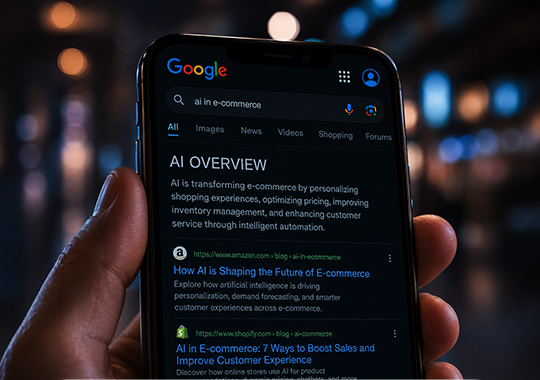
Is Your Website Ready for the Big Shift? AI Overview Is Changing the Rules of the Game

The Beauty of Promotion: How Do You Perform SEO Without Hurting Your Website’s Visibility?
