Is Your Website Ready for the Big Shift? AI Overview Is Changing the Rules of the Game
Let’s get one thing straight from the start: we’re not here to bury anyone. We have no intention of writing eulogies for any platform or interface. Google is very much alive and kicking. Before anyone starts mourning the search engine, it’s worth checking the numbers – Google search volume is growing by billions a year, with some estimates putting it between 100–250 billion, despite (and alongside) AI. That doesn’t surprise us. We’ll explain why.
That said, we do know we’re at the start of a new AI era, and now is the time to make the adjustments that matter. In this fast-moving period, we already know the next steps, the key recommendations, and the preparations every online store needs to make. In this article, we’ll walk you through the shift – the blue links that aren’t going anywhere anytime soon, and everything you need to know to get your site ready on both the SEO and GEO fronts.
A new algorithm, a new Google
A major Google algorithm update is expected to roll out in August 2026 – meaning a shift in how Google ranks and displays results. The update will favor AI Overview, which we’ll cover in detail below. Google’s changes typically appear first in the US and globally, reaching Israel a bit later, so if you haven’t caught up yet, there’s still a little time. Unlike previous updates, this one is expected to meaningfully change how Google looks and behaves. We’re already working with a number of brands and websites to get the right infrastructure in place ahead of time.
What is AI Overview? Why do we want to be there, and what does it take to qualify?
Let’s start by asking Google itself — via AI Overview — what AI Overview actually is.
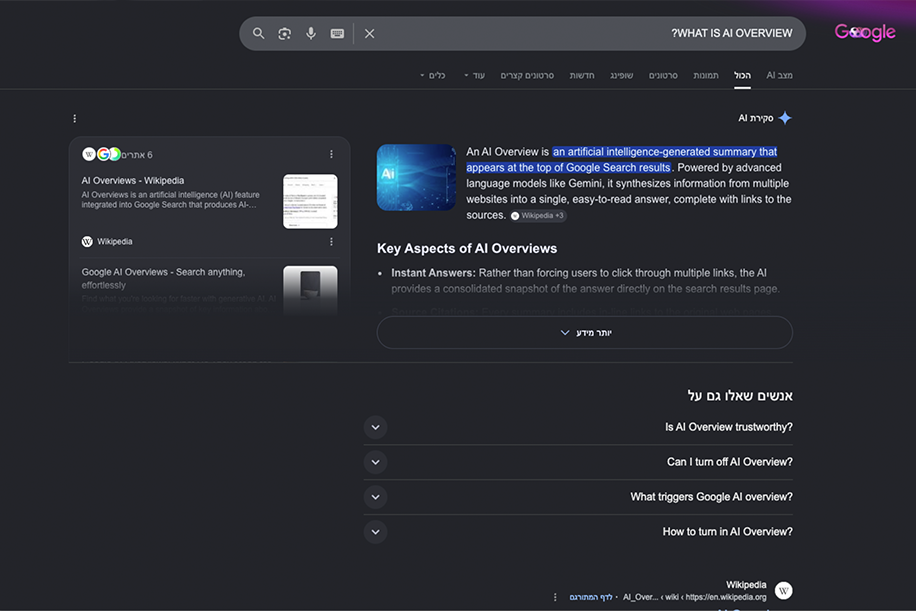
In the past, Google sometimes served up what’s known as a featured snippet: a written explanation of what you searched for, usually an answer to a question, sometimes with a critical link to a website. The featured snippet outranked the number-one result. Today, Google has replaced it with AI Overview – an AI-based mechanism that delivers a direct answer, backed by data, links, and related articles. It’s worth understanding: AI Overview might look similar to chatting with Gemini or another AI assistant, but it actually provides a short answer to the user’s request rather than opening a conversation. You can expand into a fuller discussion via AI Mode, but that’s beside the point. Google’s core goal is simple – improve search results and user satisfaction.
AI Overview counts as organic traffic from Google, and it’s one of the most important factors in your digital visibility in 2026. Since it sits at the top of the page, it captures a huge share of exposure and is increasingly driving traffic to websites. Important to note: AI Overview runs alongside Google’s existing results – commonly known as the “blue links.”
The blue links are here to stay. They’re Google’s primary revenue source, they’re still the biggest source of organic traffic to your website today, and they’re not disappearing overnight. A 2026 study that analyzed tens of thousands of queries found that Google AI Overviews appeared in about 13.7% of general queries – but for queries phrased as questions, that rate jumped to about 64.7%. Some of you might feel like AI Overview shows up in almost every search, but in reality it varies from user to user and device to device. On mobile, for instance, it currently appears far less often – though we expect that to change, and we’re already seeing meaningful mobile traffic.
Looking ahead, we understand that this shift is going to significantly affect browsing volumes – and your website. So what do you actually do? How do you prepare for changes that have already happened, and the ones still coming? Here are a few key recommendations.
First: STAY CALM. Do SEO safely and consistently.
Every SEO activity boosts your visibility across AI engines, AI Overview included. A site that doesn’t rank well on Google has, with about 99% certainty, no shot at AI Overview either – the correlation is that clear. Doing SEO over time is like going to the gym: you have to train your site to show up, and that training improves your rankings and results across the new AI engines too. We believe SEO and GEO (optimizing for AI engines) go hand in hand. On top of classic SEO practices, there are new moves worth making now, and we’ll share a few starting points here.
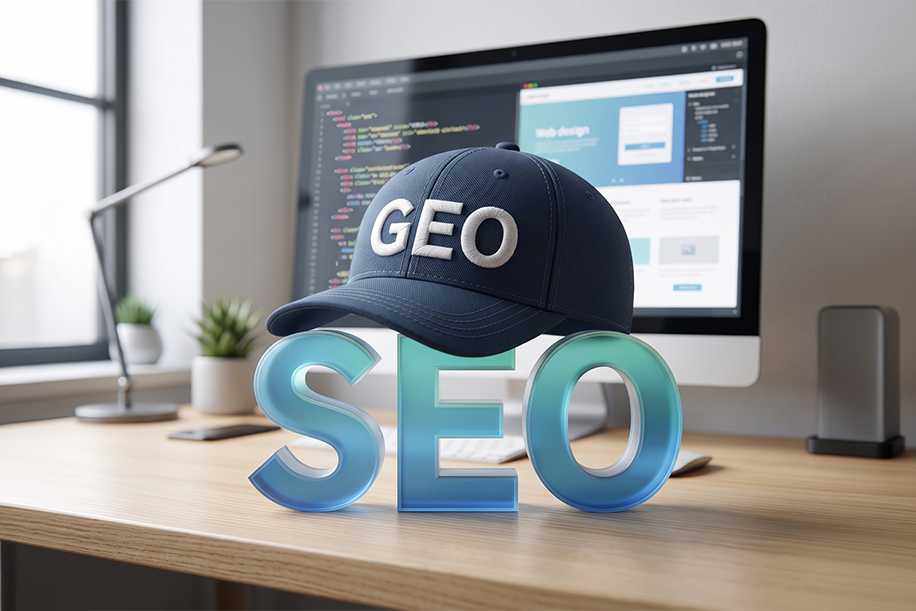 We always say GEO is basically SEO wearing a different hat.
Building trust
Like other AI engines – Claude, ChatGPT, Gemini – AI Overview treats trust as a core ranking factor. Recommending one brand, site, or product over another comes down to a trust check. Google generates citations and recommendations from external sources, and often uses your own website to build those citations and verify information. To increase the odds of that happening, you need to build strong authority with Google.
The name of the game is Authority.
One of the biggest shifts in adapting to GEO and AI Overview is moving from thinking in “search phrases” to thinking in real questions. AI engines aren’t just matching keywords – they’re trying to understand what the user is actually asking, the intent behind the question, and which answer will be clearest, most trustworthy, and most useful. That means alongside your category and service pages, it’s worth building out Q&A sections that directly answer questions like: who is this product for, what’s the difference between options, how long does the process take, what should I check before buying, and what are the pros and cons.
Question research is a practical step in building content that works for both Google and AI engines. Instead of settling for generic phrases like “moisturizer,” “gold necklace,” or “designer dresser,” look at what people are actually asking around the topic – on Google, in “People Also Ask,” through your brand’s customer service, in on-site chats, sales conversations, and social media comments. From those questions, you can build short paragraphs, FAQs, guides, comparison tables, and content that speaks the exact language your customers use.
The big advantage: Q&A-based content helps AI engines understand your site better. A clear, focused answer under a defined question is easier to pull, summarize, and cite. It also improves the user experience – visitors get a fast answer without digging further, and site owners increase their odds of showing up for long-tail, precise, high purchase-intent queries.
Content AI actually likes
Content is, without question, the most important piece of adapting to AI. You need to understand what kind of content AI favors – and the truth is, mostly deep, thorough content. AI is a little biased against itself: it prefers original, human-written content. That said, high-quality content created with AI under the guidance and oversight of a professional can still rank strongly, both in AI engines and in SEO. You need to know how to strip out the telltale signs of AI writing, and how to prompt AI properly to produce genuinely interesting content. AI loves Q&A-format content – most AI engines exist primarily to answer users’ questions.
Quality content that actually answers the user is what AI will favor. Focus matters – AI favors content that’s focused on a specific niche or area of expertise. It’s explicitly looking for expert content. We’ve seen plenty of cases where a small brand’s site outranks a big brand’s site, usually because the smaller brand’s site is far more focused on a specific niche or topic, or because it’s simply packed with high-quality content. Big brands that never bothered producing on-site content are only now starting to realize this is part of the game. AI isn’t just going to crawl product pages and serve them up to users – AI is built to deliver value, and every site that respects itself needs to start providing real information and value. Value, and a lot of it. Especially on product pages: think about how you deliver value to the visitor beyond answering FAQs – explain material quality, the benefits, and what sets the product apart. You need to create content people genuinely like, and more often than not, that’s also the content Google and other engines will favor.
Measurement and tracking – stay close to the data
Every marketing or business action requires measurement. Academics say you can’t improve what you can’t measure; in business, people say what isn’t measurable doesn’t exist. In the AI world, measurement is a little more complex. Start with AI Overview – currently counted as organic Google traffic, it blends in with the rest of your organic traffic with no clear way to separate it out, much like SEO measurement in general. Today you can cleanly separate ChatGPT traffic in your analytics, but for other AI engines, it’s a bit murkier. Measuring GEO traffic and traffic from different AI engines is a more complex process. Plenty of tools on the market promise full visibility, but reality doesn’t always match the pitch. AI isn’t a world of clean, complete data – chats are private, engines change daily, and the landscape is broad. More effective solutions do exist, and we’re happy to recommend them, but they mostly suit larger brands – smaller brands don’t always get scanned properly by global GEO tools.
It’s also worth knowing that AI chat engines deliver enormous exposure, but often with a lower click-through rate. CTR within AI-based search engines tends to be low – a lot of people search and consult, far fewer click. For non-purchase-intent topics, we’re seeing CTR as low as around 3%. That happens because the user gets their answer directly from the chat, and only afterward goes to Google to search for the brand name directly, once they’re done consulting. Bottom line: classic search and chat-based consultation are two different things.
Adapting Shopify stores – in collaboration with BOA Ideas

Adapting Shopify stores for AI Overview: BOA Ideas’ technical angle
While SEO and GEO focus on how Google and AI engines select, interpret, and present information, ecommerce stores have another critical layer: how the store is actually built behind the scenes, and how its data is served to Google – clean, consistent, and clear. That’s where BOA Ideas comes in, a software house specializing in Shopify and ecommerce development, bringing the technical side of the equation.
Shopify already provides a strong foundation for managing products, variants, inventory, pricing, collections, shipping and returns policies, Google Merchant Center integration, and structured data that helps Google better understand your product details. But in practice, simply being on the platform isn’t enough. For your store to be fully transparent to AI tools, it needs to be properly maintained at the code level – making sure variants are structured correctly, prices and inventory sync without errors, and there’s no duplicate data.
You also need to make sure third-party apps – review widgets, feeds – are integrated cleanly and don’t “break” the data Google is supposed to read. This work doesn’t replace an SEO or GEO agency – it complements it: the marketing agency defines the strategy, the questions, the messaging, and the content, while BOA makes sure the Shopify codebase can actually support it. In simple terms, the goal isn’t to guarantee an AI Overview appearance – it’s to build a cleaner, more stable, more trustworthy online store, one that Google understands better, that lets SEO, GEO, and marketing teams work on it more effectively, and that gives shoppers a better, clearer, more convenient buying experience.
A few closing words
It’s a fascinating period. Our stores and websites demand fresh thinking and a slightly different approach than what we’re used to. We’ve already started applying question research alongside keyword research, to better understand which questions people are actually asking across different AI engines.
Combine technical precision, strong and relevant content, the right trust-building moves, and smart measurement, and you can maximize your traffic through this period – and, more importantly, be genuinely ready for what’s next. Hopefully, a step ahead of everyone else.


Still curious?

How Do You Create Content Built for the AI Era?

The Beauty of Promotion: How Do You Perform SEO Without Hurting Your Website’s Visibility?
